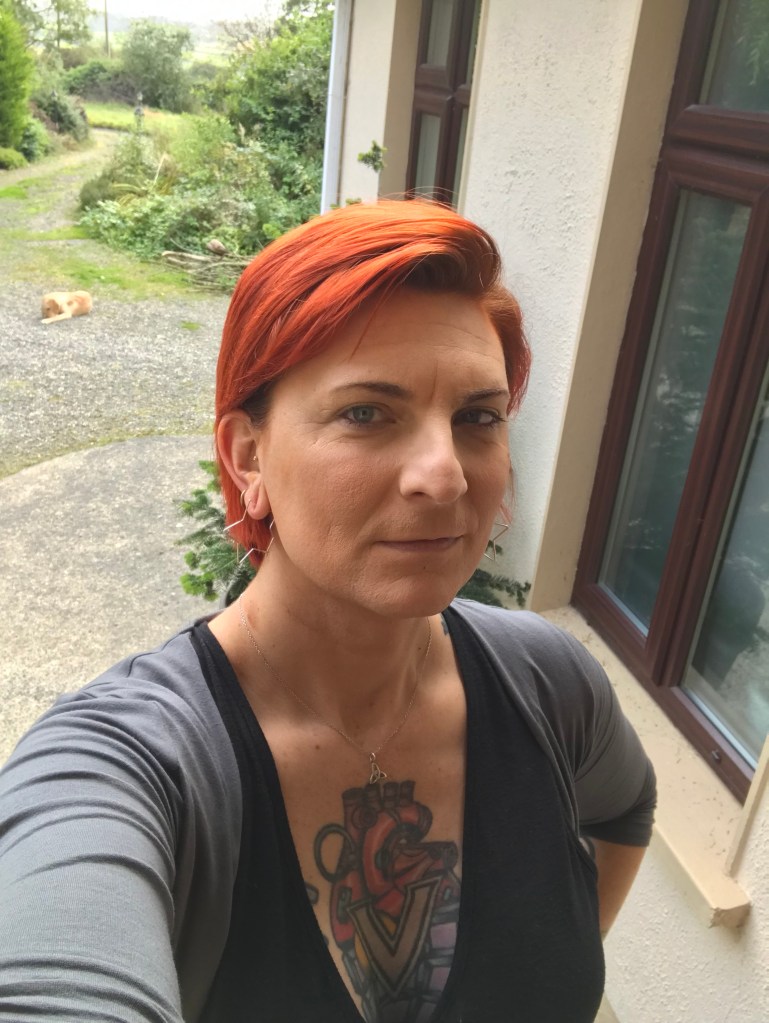
This post doesn’t deal with malicious transphobia but does explicitly talk about the unthinkingly upsetting language people use and the societal pressures to conform to a gender binary.
Jumping ahead a bit: we’re now eight months into Veronica’s social transition and five months into her medical transition. She has a decent selection of femme clothing that she seems happy with (including some nice shoes); she’s found a makeup routine that works; her hair is growing out and she’s dyed it auburn; and she’s enjoying little things like getting her nails done. She’s seen some changes due to the finasteride and estradiol too: her hormone levels are close to where she’d like them to be; she’s a couple of centimetres shorter and her hands and feet are a half-size smaller due to the effect on her ligaments; and she’s had a small amount of breast growth.
In the house, we’re living as we always have. Getting up, feeding the animals, trying to at least have two of our meals together, cuddling, watching telly, trying to take breaks from working (me) or studying (her) when the other has an emotional need to talk. I travel once a month for work, she’s away at college one full day every week. We connect as much as we can, checking in more than we ever have before to be sure we’re both doing okay with all the changes.
Our friends, neighbours, postal delivery workers, GPs and professional contacts have all been pretty good about getting Veronica’s name and pronouns right. In fact, within our circle, we haven’t really encountered anything malicious or deliberate, other than one person. I’m not going to go into that here, nor into the malicious transphobia she and I encountered outside of our circle. I’ll do that in a different post with more context to it.
However, I am going to talk about the well-meaning advice and other comments that can contribute to the discomfort and dysphoria that trans people can feel. I’m doing this with an ask: think twice before you give unsolicited advice to trans people about how they present their gender.
Without having asked them, friends and acquaintances told me or Veronica that:
- She was wearing too much makeup
- She was wearing too little makeup
- Irish women don’t wear skirts very often
- Always wearing jeans wasn’t very feminine
- Her heels were impractical for going shopping
- Her flats were a bit boyish
- Her heels made her too tall
- She should grow her hair out
- Her hair was an awkward length
- She shouldn’t worry about any visible shadow of facial hair because lots of older* women have facial hair
- Her stretched earlobes and visible hand tattoos were attracting too much attention
- Her longer fingernails weren’t normal for Irish women
- Without painted nails, her hands seem mannish
* She was 37 at the time
These might seem like well-meaning advice, intended to help her understand how cisgender Irish women behave or “fit in” with cisgender Irish women. But they were referring to a fictional person. It’s impossible to sum up cisgender Irish womanhood by height or hair length, tattoos or piercings, makeup or clothing. And by constantly (and for the first eight months, it was constant) referring to appearance, all they succeeded in doing was putting her in a state of constant self-observation. She spent ages in front of the mirror, trying to get it right. She considered doing pretty major interventions that weren’t congruent with her identity and expression. She became increasingly conservative in her appearance, in ways she had never been in the past.
I shielded her from the comments that came to me. I never passed them on and I asked people not to say them to her, a request that was most often met with “Sure, we’re only trying to help her out!”
Trans people are already our own worst critics when it comes to our gender expression. We already invest so much time in worrying if what we’ve chosen for this day will be the look that attracts abuse; if we can afford to weight our comfort against our safety; if we can find a look that ameliorates our dysphoria; if there’s a place on the gender spectrum where we can just be without people commenting and criticising and assuming. And worse.
If someone in your life starts a social transition — trans woman, trans man, agender, nonbinary, gender fluid — then the best thing to do is not say anything about their appearance*, especially where it fits on the gender spectrum or how it compares to other people on the gender spectrum. Say nothing unless you’re asked to — and even then, check what you’re actually being asked to comment on before going too far in your eagerness to help and accidentally or intentionally reinforce a strict view of gender.
* Beyond the neutral, non-gendered compliments like “You look good” or “I like that colour”
Want to support the blog, which is going to be my primary source of income moving forward? I have a Patreon account here, a Liberapay account here, and a PayPal account here.
 Partner and Ally